

NPC Page Template
APn80 - Northern Spruce Bog
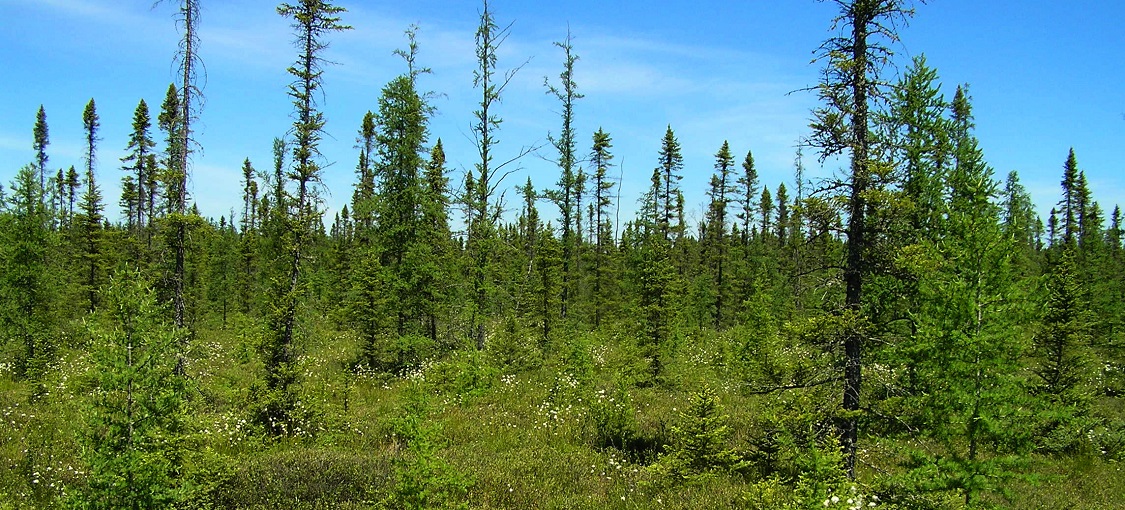
Vegetation Structure & Composition
Description is based on summary of vascular plant data from 84 plots (relevés) and bryophyte data from 17 plots.
- Moss layer consists of a carpet of Sphagnum with moderately high hummocks, usually surrounding tree bases, and weakly developed hollows. S. magellanicum dominates hummocks, with S. angustifolium present in hollows. High hummocks of S. fuscum may be present, although they are less frequent than in open bogs and poor fens. Pleurozium schreberi is often very abundant and forms large mats covering drier mounds in shaded sites. Dicranum species are commonly interspersed within the Pleurozium mats.
- Forb cover is minimal, and may include three-leaved false Solomon’s seal (Maiathemum trifolium) and round-leaved sundew (Drosera rotundifolia).
- Graminoid cover is 5-25%. Fine-leaved graminoids are most important and include three-fruited bog sedge (Carex trisperma) and tussock cottongrass (Eriophorum vaginatum).
- Low-shrub layer is prominent and dominated by ericaceous shrubs, particularly Labrador tea (Rhododendron groenlandicum), which often has >25% cover. Other ericads include bog laurel (Kalmia polifolia), small cranberry (Vaccinium oxycoccos), and leatherleaf (Chamaedaphne calyculata). Understory trees are limited to scattered black spruce.
- Canopy is dominated by black spruce. Trees are usually stunted (<30ft [10m] tall) with 25-75% cover. Some sites have scattered tamaracks in addition to black spruce. Canopy can be dense and taller than 30ft on well-developed crests of raised bogs, where surface peat is elevated above the water table and tree roots are better aerated.
Notes: Vegetation is composed only of bog species (see Appendix D in Field Guides); minerotrophic species are absent or present only as single individuals or single clones. Overall species diversity is low. In recently developed bogs, isolated minerotrophic species whose roots still have access to underlying minerotrophic groundwater may be present for a short period until overwhelmed by Sphagnum development. When upland seed sources are present nearby, seedlings of deciduous tree species (especially red maple, northern red oak, or paper birch) may be present on Sphagnum hummocks but do not survive to become saplings or trees.
Landscape Setting and Soils
APn80 is most extensive and best developed in peatlands on the eastern Agassiz, Aitkin, and Upham glacial lake plains, where underlying impermeable clay layers minimize groundwater movement through the peat. APn80 also occurs in peat-filled basins on nutrient-poor outwash plains, in scoured bedrock terrain, and on non-calcareous till. On these landforms, the basins are in small watersheds and receive minimal surface water input. APn80 can also occur on floating mats bordering low-alkalinity lakes and ponds. Soils are typically deep peat (>40in [1m]), although peat depth can be less in scoured bedrock landscapes or on nutrient-poor sand plains. The upper peat layer is poorly decomposed (fibric) peat formed from Sphagnum. It may be underlain by more decomposed peat of variable origin. Surface water is very acidic (pH <4.2), and mineral concentrations, particularly Ca++, are extremely low. Water table is usually at or near the surface but can drop during periods of drought.