

NPC Page Template
FDc23 - Central Dry Pine Woodland
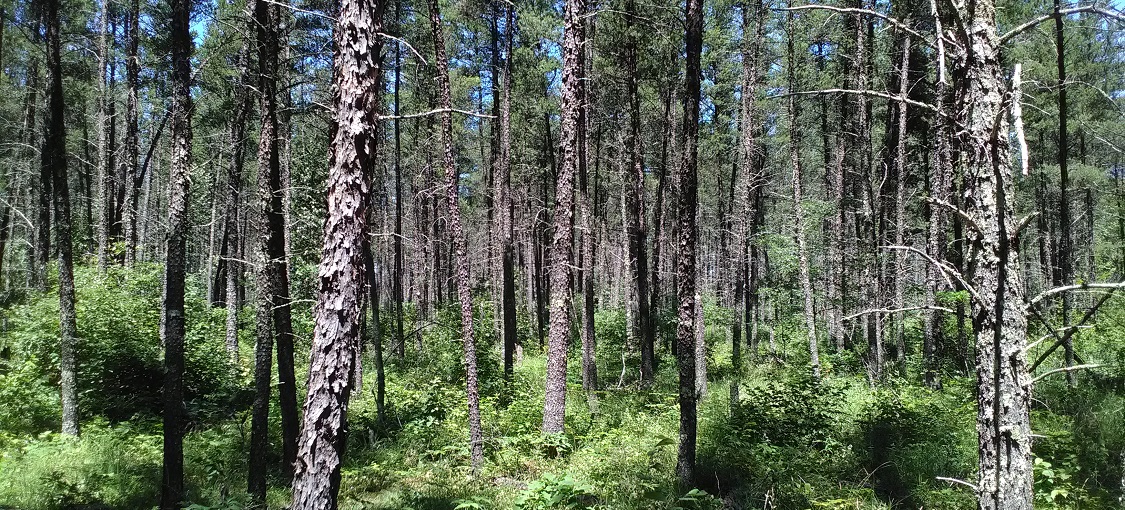
Vegetation Structure & Composition
Description is based on summary of vegetation data from 37 plots (relevés).
- Ground-layer is sparse to patchy (5-50% cover), composed mostly of dry woodland and shade-intolerant species. Pennsylvania sedge (Carex pensylvanica) is common and often abundant. Other frequent species include Canada mayflower (Maianthemum canadense), northern bedstraw (Galium boreale), common strawberry (Fragaria virginiana), yarrow (Achillea millefolium), and mountain rice grass (Oryzopsis asperifolia). Prairie grasses and forbs are also usually present, especially big bluestem (Andropogon gerardii) and hoary puccoon (Lithospermum canescens), with skyblue aster (Symphyotrichum oolentangiense), smooth blue aster (S. laeve), Virginia ground cherry (Physalis virginiana), oval-leaved milkweed (Asclepias ovalifolia), and alumroot (Heuchera richardsonii) less frequent.
- Shrub-layer is patchy (25-50% cover), with American hazelnut (Corylus americana) common and often abundant. Other typical species in the tall-shrub layer are northern red oak and bur oak saplings, juneberries (Amelanchier spp.), and chokecherry (Prunus virginiana). Common low shrubs or half-shrubs include prickly or smooth wild rose (Rosa acicularis/blanda), prairie willow (Salix humilis), and lowbush blueberry (Vaccinium angustifolium).
- Subcanopy is poorly developed or absent.
- Canopy is interrupted to continuous (50-100% cover) and strongly dominated by jack pine with occasional quaking aspen, northern red oak, or red pine.
Landscape Setting and Soils
Outwash plains and other flat, sandy landforms — Common. Parent material is well-sorted sand, occasionally with lenses of gravel but lacking large stones. Originally the parent material was weakly calcareous, but free carbonates have been leached from the upper 60in (150cm). The soil surface is often dark in the upper 10in (25cm) because of incorporated organic matter, which indicates that some of these sites were formerly occupied by deciduous woodlands or prairies. Subsoil horizons that retain snowmelt or rainfall are absent. Soils are somewhat excessively drained. Soil-moisture regime is moderately dry. (Pine Moraines & Outwash Plains and Chippewa Plains in MDL; WSU)