

NPC Page Template
FDc24 - Central Rich Dry Pine Woodland
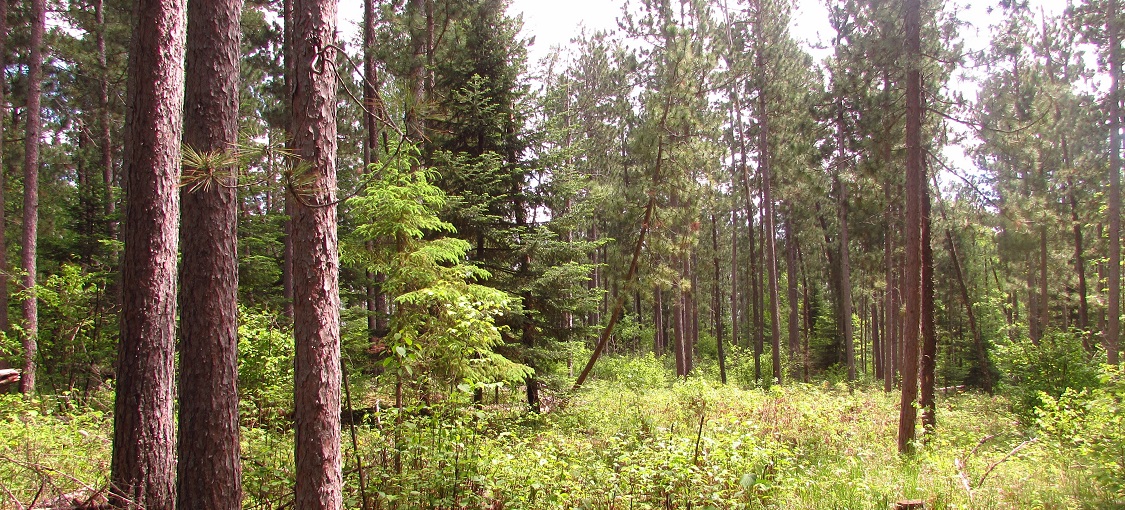
Vegetation Structure & Composition
Description is based on summary of vegetation data from 35 plots (relevés).
- Ground-layer is variable in cover, ranging from sparse to continuous (5-100% cover). Bracken (Pteridium aquilinum) and Pennsylvania sedge (Carex pensylvanica) are often abundant when present. Other common species are Canada mayflower (Maianthemum canadense), northern bedstraw (Galium boreale), mountain rice grass (Oryzopsis asperifolia), and common strawberry (Fragaria virginiana). Patches of moss are typical, with Pleurozium schreberi most commonly reported.
- Shrub-layer is dense (often with >75% cover); beaked hazelnut (Corylus cornuta) and American hazelnut (Corylus americana) are usually abundant. Other common shrub or half-shrub species include prickly or smooth wild rose (Rosa acicularis/blanda group), juneberries (Amelanchier spp.), poison ivy (Toxicodendron rydbergii), and lowbush blueberry (Vaccinium angustifolium), with bush honeysuckle (Diervilla lonicera) abundant in some sites.
- Subcanopy is absent or poorly developed.
- Canopy is interrupted to continuous (50-100% cover) and strongly dominated by jack pine with minor amounts of paper birch, red pine, quaking aspen, bur oak, and northern red oak.
Landscape Setting and Soils
- Outwash plains — Common. Landscape is flat to rolling, with deep soils. Parent material is well-sorted sand, often with gravelly lenses but no large stones. Originally the parent material was calcareous, but free carbonates are now at least 30in (75cm) below the soil surface. Soil surface is somewhat dark to very dark in the upper 10in (25cm) because of incorporated organic matter, which indicates that these sites were formerly occupied by deciduous woodlands or prairies. Subsoil horizons that can perch snowmelt or rainfall are absent, although the organic-enriched surface horizons and complex textural banding in the lower horizons help to hold rainfall during the growing season. Soils are somewhat excessively drained. Soil-moisture regime is moderately dry to moderately fresh. (Chippewa Plains and Pine Moraines & Outwash Plains in MDL)
- Stagnation moraines and till plains — Rare. Present on flat, local deposits of sand within otherwise hummocky or rolling landscapes. Originally the sandy parent material was calcareous, but free carbonates are now at least 60in (150cm) below the soil sur- face. Soil surface is somewhat darkened because of incorporated organic matter, which indicates that these sites were formerly occupied by deciduous brushland or woodland. The organic-enriched surface horizons and complex textural banding present in lower horizons help to hold rainfall during the growing season. Soils are well drained to some- what excessively drained. Soil-moisture regime is moderately dry to moderately fresh. (Hardwood Hills in MIM, St. Louis Moraines and Pine Moraines & Outwash Plains in MDL)