

NPC Page Template
FDc34 - Central Dry-Mesic Pine-Hardwood Forest
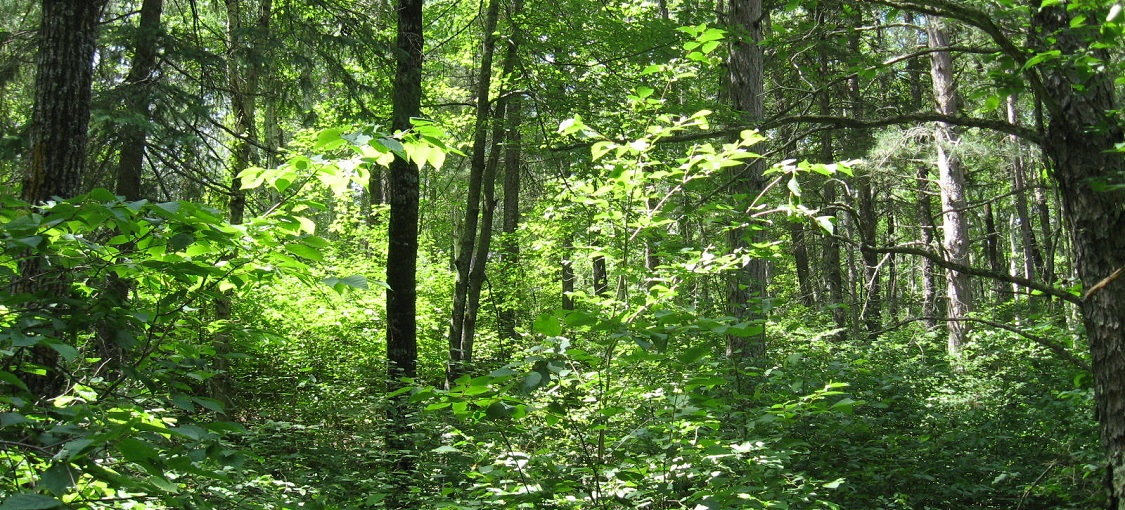
Vegetation Structure & Composition
Description is based on summary of vegetation data from 51 plots (relevés).
- Ground-layer is patchy to continuous (25- 100% cover) with abundant large-leaved aster (Eurybia macrophylla). Other common species include Canada mayflower (Maianthemum canadense), wild sarsaparilla (Aralia nudicaulis), bracken (Pteridium aquilinum), and early meadow-rue (Thalictrum dioicum).
- Shrub-layer is interrupted to continuous (50-100% cover) with abundant beaked hazelnut (Corylus cornuta) and occasional red maple saplings, bush honeysuckle (Diervilla lonicera), chokecherry (Prunus virginiana), and juneberries (Amelanchier spp.).
- Subcanopy is patchy (25-50% cover), with red maple sometimes abundant.
- Canopy is interrupted to continuous (50-100% cover) and variable in composition, but most commonly dominated by red pine or white pine, or a mixture of the two, with smaller amounts of paper birch, quaking aspen, red maple, jack pine, northern red oak, and bur oak. Less commonly, canopy is dominated by a combination of northern red oak, quaking aspen, paper birch, red maple, bur oak, big- toothed aspen, and basswood. In mixed pine-hardwood forests, pines often form a taller supercanopy over a shorter canopy of hardwoods.
Landscape Setting and Soils
Stagnation Moraines — Common. Present mainly on hummocky terrain adjacent to fire-prone outwash plains. Parent material is a discontinuous cap of partially sorted sand and gravel over a base of denser till, and is often complexly stratified. The under- lying clayey till is normally more than 60in (150cm) below the soil surface but can be at or near the surface on hilltops. This parent material initially was calcareous, but free carbonates are usually leached to depths greater than 30in (75cm). Water retention in these soils is related to stratification in the sand or gravel cap and depth to the underlying clayey till. Where the cap is thick or poorly stratified, soils are somewhat excessively drained, and the soil-moisture regime is moderately dry. Where the cap is thinner or well stratified, soils are well drained, and the soil-moisture regime is moderately fresh or fresh. (Chippewa Plains, Pine Moraines & Outwash Plains, and St. Louis Moraines in MDL; Hardwood Hills in MIM; and WSU)