

NPC Page Template
FDn12 - Northern Dry-Sand Pine Woodland
Vegetation Structure & Composition
Description is based on summary of vegetation data from 22 plots (relevés).
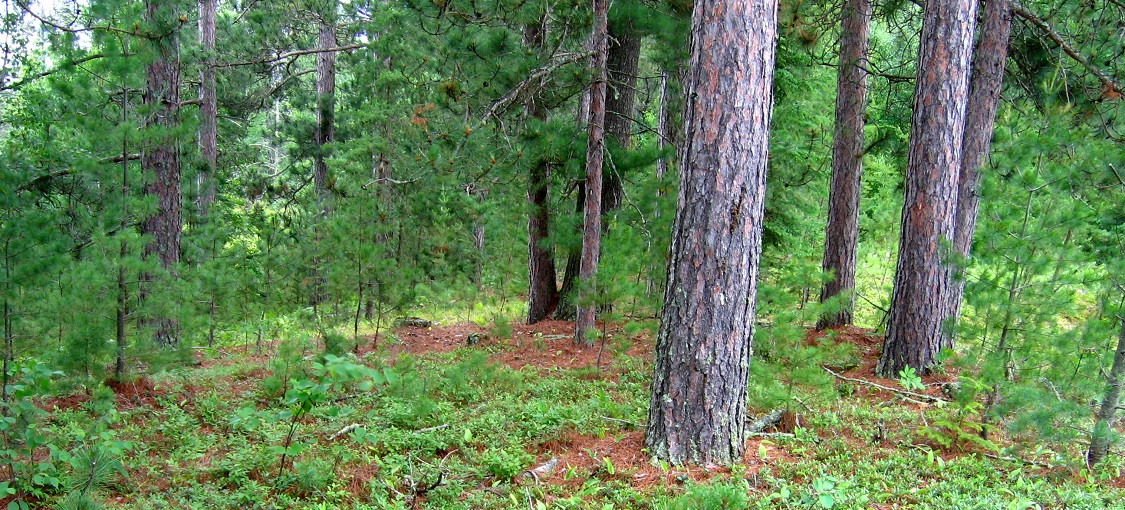
- Ground-layer plants are often interspersed with patches of lichens and bare soil. Bracken (Pteridium aquilinum), Canada mayflower (Maianthemum canadense), and mountain rice grass (Oryzopsis asperifolia) are usually the most abundant species. Broad-leaved evergreen ground-layer species such as pipsissewa (Chimaphila umbellata), wintergreen (Gaultheria procumbens), bearberry (Arctostaphylos uva-ursi), and trailing arbutus (Epigaea repens) are a common and characteristic feature of the community.
- Shrub-layer is sparse to patchy (5-50% cover). Lowbush blueberry (Vaccinium angustifolium), juneberries (Amelanchier spp.), wild roses (Rosa spp.), and beaked hazelnut (Corylus cornuta) are present in nearly all sites, while bush honeysuckle (Diervilla lonicera), when present, is abundant.
- Subcanopy is absent or poorly differentiated from the canopy.
- Canopy most commonly is interrupted (50-75% cover) but ranges from patchy to continuous (25-100%). Dominated by jack pine or red pine with occasional balsam
Landscape Setting and Soils
- Outwash plains — Common. Landscape is level to rolling. Parent material is well- sorted sand, occasionally with lenses of gravel. Originally the parent material was calcareous, but free carbonates have been leached from the upper 60in (150cm). Subsoil horizons that can retain snowmelt or rainfall are absent, but fine textural banding is common between 40in-60in (100-150cm) deep and helps to retain some water. Soils are excessively to somewhat excessively drained. Soil-moisture regime is moderately dry. (Chippewa Plains, St. Louis Moraines, and Pine Moraines & Outwash Plains in MDL; Agassiz Lowlands in MOP)
- Lake plains — Common. Landscape is level. Parent material is very well-sorted, fine sandy lacustrine sediments lacking gravel or stones. Originally the parent material was calcareous, but free carbonates have been leached from the upper 60in (150cm). Distinctly gray upper horizons are typical, indicating a long history of conifer cover. Subsoil horizons that can retain snowmelt or rainfall are absent, but the overall landscape is clayey beneath the sand, and soils can be wet during snowmelt. Gray and bright soil colors indicate that the local water table is within the rooting zone in the spring and then falls to below 60in (150cm) early in the growing season. Soils are moderately well drained. Soil-moisture regime is moderately dry. (MOP, and Tamarack Lowlands in MDL)
- Stagnation moraines — Occasional. Present on flat, local deposits of sand and gravel within otherwise hummocky landscapes. Parent material is partially sorted sand with occasional lenses of gravel. Originally the parent material was calcareous, but free carbonates have been leached from the upper 30in (75cm). Distinctly gray upper horizons are typical, indicating a long history of conifer cover. Subsoil horizons that can retain snowmelt or rainfall are absent, but complex banding throughout the soil profile is common and helps to retain some water. Soils are somewhat excessively drained. Soil- moisture regime is moderately dry. (St. Louis Moraines and Chippewa Plains in MDL)