

NPC Page Template
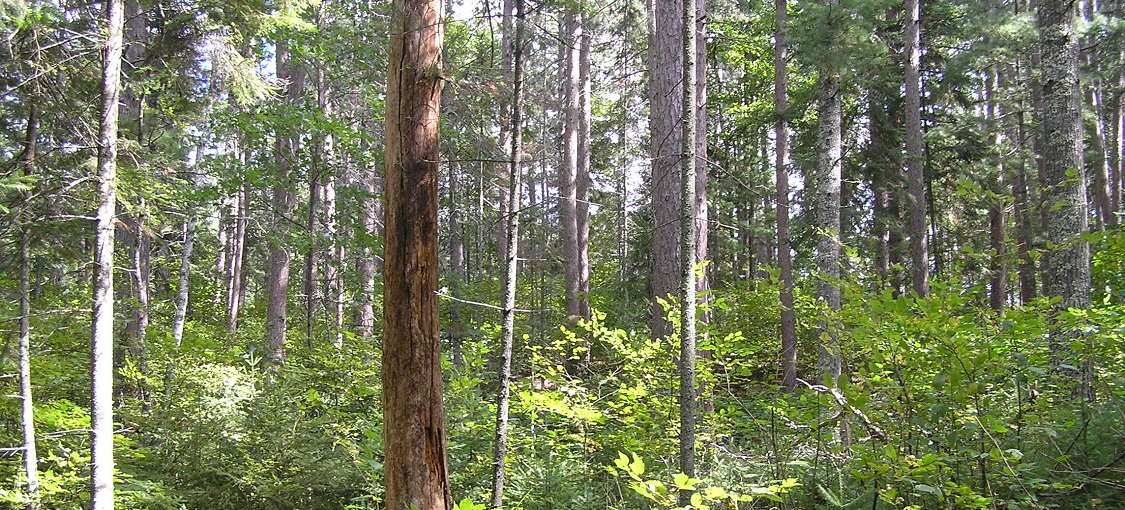
FDn33 - Northern Dry-Mesic Mixed Woodland
Vegetation Structure & Composition
Description is based on summary of vegetation data from 124 plots (relevés).
- Ground-layer cover is variable, with Canada mayflower (Maianthemum canadense), wild sarsaparilla (Aralia nudicaulis), large- leaved aster (Eurybia macrophylla), bracken (Pteridium aquilinum), and mountain rice grass (Oryzopsis asperifolia) as the most important species.
- Shrub-layer is patchy to continuous (25-75% cover). Beaked hazelnut (Corylus cornuta) is present on nearly all sites and is usually abundant, with 40% average cover. Juneberries (Amelanchier spp.) and bush honeysuckle (Diervilla lonicera) are present in most sites. Red maple and balsam fir saplings are also common.
- Subcanopy most often is absent or sparse. Paper birch, balsam fir, and red maple are the most frequent subcanopy species.
- Canopy cover is variable but most commonly is interrupted (50-75%). Canopy composition is often mixed but ranges from solely coniferous to solely deciduous. The most important canopy species are red pine, paper birch, white pine, quaking aspen, red maple, jack pine, big-toothed aspen, and in northwestern Minnesota, black spruce.
Landscape Setting and Soils
- Outwash plains and dune fields — Common. Landscape is level to rolling. Parent material is composed mostly of loamy sand or loamy fine sand. This material was initially calcareous, but free carbonates have almost always been leached to depths greater than 60in (150cm). Soils lack subsoil horizons that can perch snowmelt, but complex stratification can cause some retention of rainfall in the rooting zone. Gray and bright colors in the deepest soil horizons suggest that the local water table can occasionally rise to within 40in (100cm) of the soil surface in the spring but falls rapidly in the early growing season. Soils are well drained to somewhat excessively drained. Soil-moisture regime is moderately dry. (Chippewa Plains and Pine Moraines & Outwash Plains in WSU; North Shore Highlands in NSU)
- Scoured bedrock terrain — Occasional. Present on level to moderately sloping sites in otherwise rugged landscapes. Parent material available for soil development consists of shallow loamy till or finer material washed into crevices in the rock. Exposed bedrock and boulder-sized rocks are usually evident. Soil depths are typically less than 12in (30cm). Where soils are deeper, the upper horizons are often gray and strongly leached, suggesting a long history of conifer cover. Mosses, lichens, and organic litter are also important substrates for ground-layer plants. These sites are excessively drained. Soil-moisture regime is dry. (Border Lakes and North Shore Highlands in NSU)
- Stagnation moraines and till plains — Occasional. Present on level sites within hummocky or rolling landscapes. Parent material is stratified sand, often with modest amounts of gravel and rarely with stones. The surface tends to be loamy sand, with coarser sand in deeper horizons. Soils are well drained to somewhat excessively drained. Soil-moisture regime is moderately dry. (Pine Moraines & Outwash Plains and St. Louis Moraines in MDL; Border Lakes and North Shore Highlands in NSU)
- Inter-beach deposits — Rare. Landscape is level to gently undulating. Parent material is very well-sorted fine sand that lacks gravel and large stones. Distinctly gray upper soil horizons are present, suggesting a fairly long history of conifer cover. Soils lack subsoil horizons that can perch snowmelt, but the overall landscape is clayey beneath the sand, and soils can be wet during spring snowmelt. Gray and bright colors in the soil indicate that the local water table is within 15in (40cm) of the soil surface in the spring but falls to about 60in (150cm) early in the growing season. Soils are moderately well to somewhat poorly drained. Soil-moisture regime is moderately moist. (Agassiz Lowlands in MOP)