

NPC Page Template
FDn43 - Northern Mesic Mixed Forest
Vegetation Structure & Composition
Description is based on summary of vegetation data from 203 plots (relevés).
- Ground-layer ranges from patchy to continuous (25-100% cover). Common species include wild sarsaparilla (Aralia nudicaulis), large-leaved aster (Eurybia macrophylla), bluebead lily (Clintonia borealis), bunchberry (Cornus canadensis), and Canada mayflower (Maianthemum canadense).
- Shrub-layer is variable in cover and dominated by deciduous species. Beaked hazelnut (Corylus cornuta), fly honeysuckle (Lonicera canadensis), and mountain maple (Acer spicatum) are the most frequent shrubs.
- Subcanopy is usually poorly defined and sparse, although nearly three-quarters of all sites have at least some balsam fir.
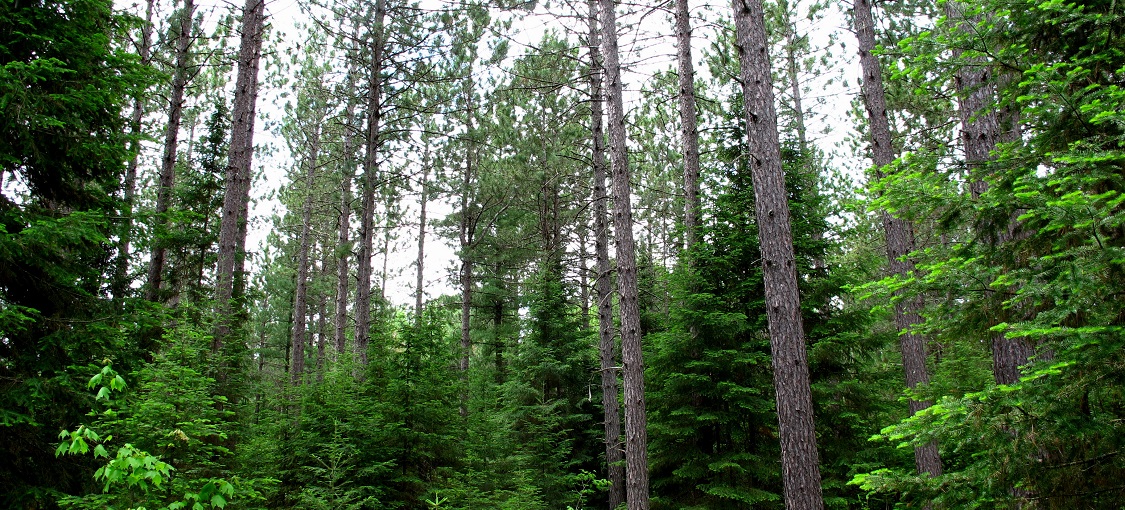
- Canopy composition is often mixed but ranges from solely deciduous to solely coniferous, with variable cover. Important canopy species include paper birch, quaking aspen, white pine, balsam fir, white spruce, red pine, and white cedar.
Landscape Setting and Soils
- Scoured bedrock terrain — Common. Present on deep glacial till deposits in landscapes characterized by shallow soils over bedrock. Parent material is loamy, non-calcareous till. Exposed bedrock and boulder-sized rocks are rarely evident. Soils show some deposition of organic material and iron compounds in lower horizons due to a long history of conifer cover. The till is stony at depth and densely packed, making it capable of perching snowmelt in flat or concave spots. Soils are well drained and droughty by late summer. Soil-moisture regime is moderately fresh. (Border Lakes and North Shore Highlands in NSU)
- Stagnation moraines and till plains — Common. Present on flat, local deposits of sand and gravel in otherwise hummocky or rolling landscapes. Parent material is non- calcareous, loamy or fine-sandy drift that is often gravelly and occasionally stony. Soils show some deposition of organic material and iron compounds in lower horizons due to a long history of conifer forest cover. The drift is stony at depth and densely packed, making it capable of perching snowmelt in locally flat or concave spots. Soils are well drained and are droughty by late summer. Soil-moisture regime is moderately fresh. (North Shore Highlands, Toimi Uplands, and Laurentian Uplands in NSU; WSU)
- Outwash plains — Occasional. Parent material is non-calcareous loamy sand often with gravelly lenses and generally lacking large stones. Distinctly gray surface soil horizons and deposits of iron compounds deeper in the soil indicate a long history of conifer cover. Subsoil horizons that can cause retention of snowmelt or rainfall are absent. Soils are somewhat excessively drained and are droughty by late summer. Soil-moisture regime is moderately dry to moderately fresh. (WSU, North Shore Highlands in NSU)