

NPC Page Template
FDs38 - Southern Dry-Mesic Oak-Hickory Woodland
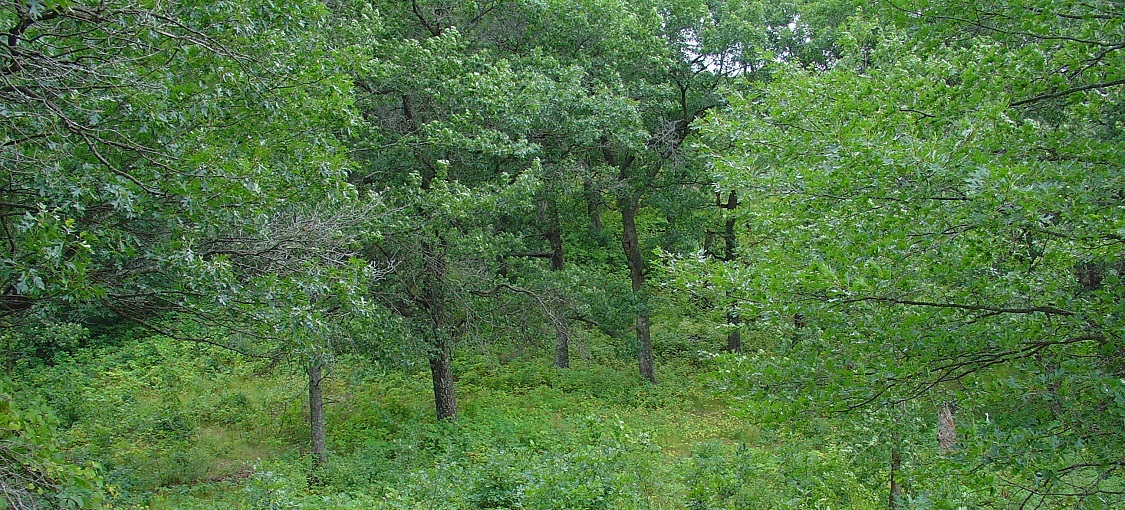
Vegetation Structure & Composition
Description is based on summary of vegetation data from 17 plots (relevés).
- Ground-layer cover is mostly patchy to continuous (25-100%). Important species include woodland sunflower (Helianthus strumosus), white snakeroot (Ageratina altissima), elm-leaved goldenrod (Solidago ulmifolia), shining bedstraw (Galium concinnum), Canadian and gregarious black snackroots (Sanicula canadensis and S. gregaria), and heart-leaved alexanders (Zizia aptera). Other common species include honewort (Cryptotaenia canadensis), Clayton’s sweet cicely (Osmorhiza claytonii), lopseed (Phryma leptostachya), pointed-leaved tick trefoil (Desmodium glutinosum), hog peanut (Amphicarpaea bracteata), common enchanter’s nightshade (Circaea lutetiana), and Pennsylvania sedge (Carex pensylvanica).
- Climbing plants and vines are sparse to patchy (5-50% cover); greenbrier (Smilax tamnoides), wild grape (Vitis riparia), and Virginia creeper (Parthenocissus vitacea) are often present.
- Shrub-layer cover ranges from patchy to often dense (25-100%). Shagbark hickory and hackberry are important tree saplings. Other common species include American hazelnut (Corylus americana), gray dogwood (Cornus racemosa), poison ivy (Toxicodendron rydbergii), prickly ash (Zanthoxylum americanum), prickly gooseberry (Ribes cynosbati), red raspberry (Rubus idaeus), black cherry, and American elm.
- Subcanopy is patchy to continuous (25-100% cover) and often poorly differentiated from the canopy. Shagbark hickory, black cherry, hackberry, and black walnut are characteristic; other common species include American elm, red elm, box elder, bur oak, and paper birch.
- Canopy cover is interrupted to continuous (75-100%), often with large, open-grown trees present. Bur oak, shagbark hickory, American elm, black walnut, and box elder are characteristic. Other common species include northern pin oak, white oak, northern red oak, and black cherry.
Landscape Setting and Soils
Steep, loess-covered bedrock bluffs — Common. Present in dissected bedrock terrain where little of the original plateau remains as interfluves between stream valleys. Most common on steep, south-facing slopes. Parent material is a mantle of wind-deposited silt about 15-30in (50-75cm) thick over older soil surfaces. The old soils are calcareous, but the wind-deposited silt is not. Depth to bedrock generally exceeds 30in, although cobbles and flagstones are common throughout the soil profile. Outcrops of sandstone, limestone, or dolomite are occasionally present. Soils have dark surface horizons, suggesting that these sites are formerly occupied by prairies or open woodlands, or that the post-fire condition of this community is prairie-like. Some subsoil horizons have modest accumulations of clay, but these horizons do not appear to perch water, either because they are poorly developed or because the typically steep slopes promote drainage. Soils deeper than 60in (150cm) over bedrock are well drained and have a fresh soil-moisture regime. Shallower soils over bedrock are excessively drained and have a dry soil-moisture regime. (Blufflands in PPL)