

NPC Page Template
FDw44 - Northwestern Wet-Mesic Aspen Woodland
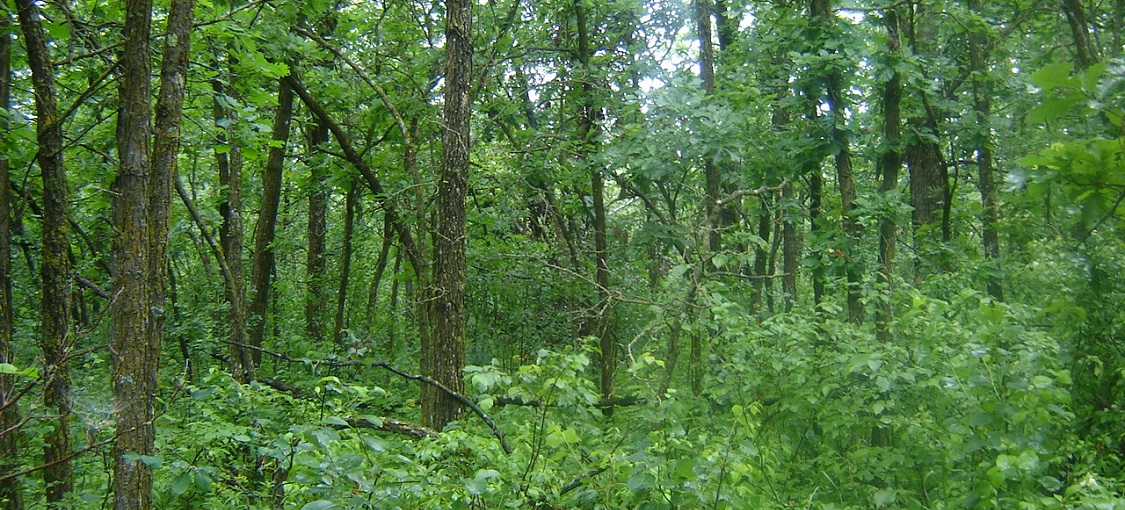
Vegetation Structure & Composition
Description is based on summary of vegetation data from 44 plots (relevés).
- Ground-layer cover is sparse to patchy (5-50%). Common species include starry false Solomon’s seal (Maianthemum stellatum), common strawberry (Fragaria viginiana), northern bedstraw (Galium boreale), Maryland black snakeroot (Sanicula marilandica), tall meadow-rue (Thalictrum dasycarpum), dwarf raspberry (Rubus pubescens), Canada goldenrod (Solidago canadensis), wild sarsaparilla (Aralia nudicaulis), bluejoint (Calamagrostis canadensis), and Pennsylvania sedge (Carex pensylvanica).
- Shrub-layer cover is patchy to interrupted (25-75%). Bur oak, quaking aspen, prickly or smooth wild rose (Rosa acicularis or R. blanda), juneberries (Amelanchier spp.), American hazelnut (Corylus americana), gray dogwood (Cornus racemosa), red-osier dogwood (Cornus sericea), and poison icy (Toxicodendron rydbergii) are all common.
- Subcanopy cover is sparse to patchy (5-50%). Quaking aspen is common although not abundant, with occasional bur oak, balsam poplar, American elm, and green ash.
- Canopy cover is patchy to interrupted (25-75%). The most important species is quaking aspen. Bur oak is present occasionally although typically not abundant; balsam poplar can be abundant when present. American elm, white spruce, and green ash may also be present.
Landscape Setting and Soils
Glacial lake plains — Common. Present on flat, sandy sites on the Glacial Lake Agassiz plain and on the Anoka Sand Plain. Parent material is very well sorted, fine sand characteristic of shallow water deposits. Typically this material is > 60in (150cm) deep, stoneless, and leached carbonates. On occasion the fine sand is deposited over calcareous gravelly till. Soil surface is nearly black in the upper 7-15in (20-40cm) due to incorporated organic matter. Soils lack clayey subsoil horizons capable of perching snowmelt or rainfall. Soil colors and bright mottles indicate that soils are saturated in the spring and dry to about 30in (75cm), but not much deeper, during the growing season. Soils are moderately well drained to somewhat poorly drained. Soil-moisture regime is very moist. (LAP; Anoka Sand Plain Subsection in MIM)