

NPC Page Template
MHc26 - Central Dry-Mesic Oak-Aspen Forest
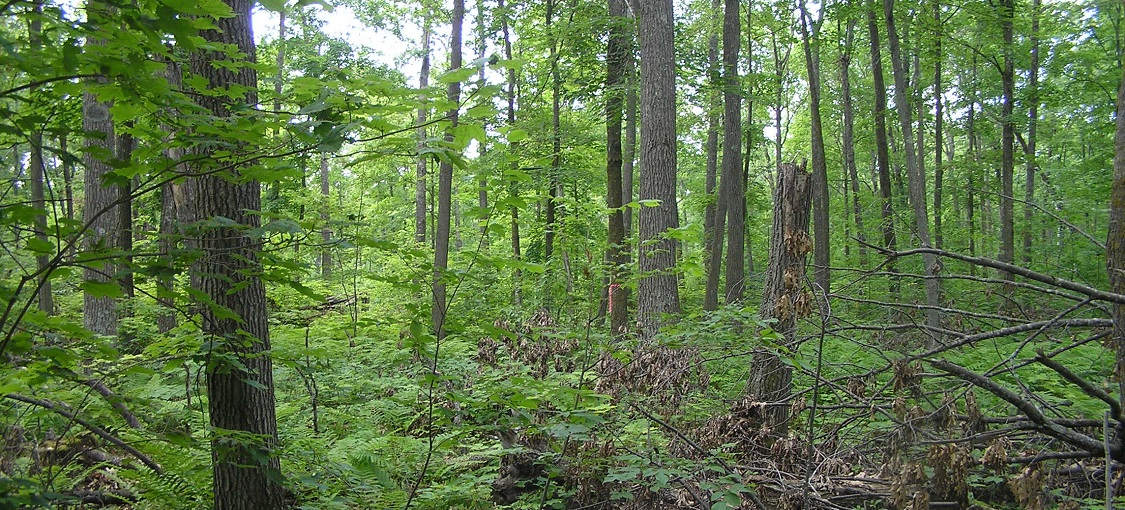
Vegetation Structure & Composition
Description is based on summary of vegetation data from 131 plots (relevés).
- Ground-layer has variable cover; the most frequent species are large-leaved aster (Eurybia macrophylla), Pennsylvania sedge (Carex pensylvanica), wild sarsaparilla (Aralia nudicaulis), bracken (Pteridium aquilinum), early meadow-rue (Thalictrum dioicum), hog peanut (Amphicarpaea bracteata), mountain rice grass (Oryzopsis asperifolia), pale bellwort (Uvularia sessilifolia), wood anemone (Anemone quinquefolia), Canada mayflower (Maianthemum canadense), large-flowered bellwort (Uvularia grandiflora), and Maryland black snakeroot (Sanicula marilandica).
- Shrub-layer cover ranges from patchy to continuous (25-100%). Beaked hazelnut (Corylus cornuta) is almost always abundant (>25% average cover), with chokecherry (Prunus virginiana), downy arrowwood (Viburnum rafinesquianum), and juneberries (Amelanchier spp.) often present but not necessarily abundant. Tree seedlings are also common, especially northern red oak, red maple, and sugar maple.
- Subcanopy cover is variable, with sugar maple, ironwood, red maple, and basswood the most important species.
- Canopy is interrupted to continuous (50-100% cover). Northern red oak is usually dominant in the canopy, with paper birch, red maple, quaking aspen, basswood, sugar maple, bur oak, and big-toothed aspen sometimes important. White pine and red pine are occasionally present.
Landscape Setting and Soils
- Stagnation moraines — Common. Landscape is hummocky. Parent material is a discontinuous cap of partially sorted sand and gravel over a core of denser till. The parent material is either non-calcareous or has been leached of carbonates. Where this sandy and gravelly cap is thick, soils are somewhat excessively drained, and the soil-moisture regime is moderately dry. Where the cap is thinner than 60in (150cm), soils are well to moderately well drained. Soil-moisture regime is moderately fresh to fresh. (MDL (except Tamarack Lowlands); WSU)
- Till plains — Common. Landscape is rolling to hummocky. Parent material is non- calcareous, coarse-textured, sandy loam drift. Soils have very slight accumulations of clay in the subsoil horizons and are weakly cemented, enabling them to perch some snowmelt and rainwater. Where subsoil horizons are well developed, soils are well drained, and the soil-moisture regime is fresh. Where subsoil horizons are poorly developed, soils are somewhat excessively drained and the soil-moisture regime is moderately dry. (Pine Moraines & Outwash Plains in MDL; WSU)
- Glacial river terraces — Rare. Topography is flat. Parent material consists of deep deposits of sand and gravel over bedrock terraces eroded by torrential glacial streams during the formation of the St. Croix and Kettle River valleys. These terraces are well above modern river levels and do not flood. Soils are somewhat excessively drained. Soil-moisture regime is moderately dry. (WSU)