

NPC Page Template
MHc36 - Central Mesic Hardwood Forest (Eastern)
Vegetation Structure & Composition
Description is based on summary of vegetation data from 95 plots (relevés).
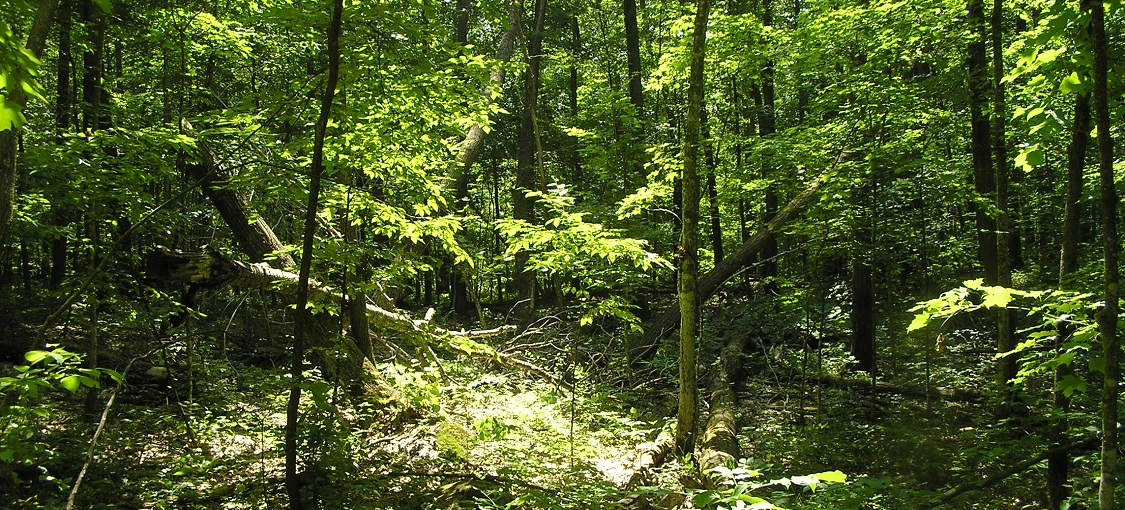
- Ground-layer cover ranges from patchy to interrupted (25-75%). Common species include early meadow-rue (Thalictrum dioicum), lady fern (Athyrium filix-femina), large-flowered bellwort (Uvularia grandiflora), Clayton’s sweet cicely (Osmorhiza claytonii), Pennsylvania sedge (Carex pensylvanica), large-leaved aster (Eurybia macrophylla), wild sarsaparilla (Aralia nudicaulis), zigzag goldenrod (Solidago flexicaulis), hog peanut (Amphicarpaea bracteata), and rugulose and yellow violets (Viola canadensis/pubescens group).
- Shrub-layer cover is variable; important species include chokecherry (Prunus virginiana), pagoda dogwood (Cornus alternifolia), prickly gooseberry (Ribes cynosbati), and beaked hazel (Corylus cornuta), along with sugar maple, ironwood, basswood, and northern red oak seedlings and small saplings.
- Subcanopy cover is variable; sugar maple is the most important species, followed by ironwood and basswood.
- Canopy is continuous (>75% cover), usually dominated by basswood, northern red oak, and sugar maple. Minor canopy species include green ash, paper birch, red maple, bur oak, and quaking aspen.
Landscape Setting and Soils
- Stagnation moraines — Common. Landscape is hummocky with highly variable relief. Parent material is predominantly non-calcareous or weakly calcareous fine-textured till, often with a shallow cap of coarser, partially sorted drift. Soils have firm, sandy clay- loam subsoil horizons capable of perching snowmelt and rainfall well above the local water table. On upper slopes, soils do not perch water for long and are well drained with a fresh soil-moisture regime. On lower slopes, soils can perch water for prolonged periods and are moderately well drained with a very fresh or moderately moist soil-moisture regime. (WSU; Hardwood Hills in MIM)
- Till plains — Occasional. Landscape is undulating to rolling. Parent material is non- calcareous gravelly, sandy-loam till. Soils have very firm and partially cemented lower horizons capable of perching snowmelt and rainfall. Gray soil colors just above the lower horizons indicate a thin (~10in [25cm]) zone of saturated soil that persists well into the growing season. Soils are well drained to moderately well drained. Soil-moisture regime is fresh or moderately moist. (WSU)