

NPC Page Template
MHc47 - Central Wet-Mesic Hardwood Forest
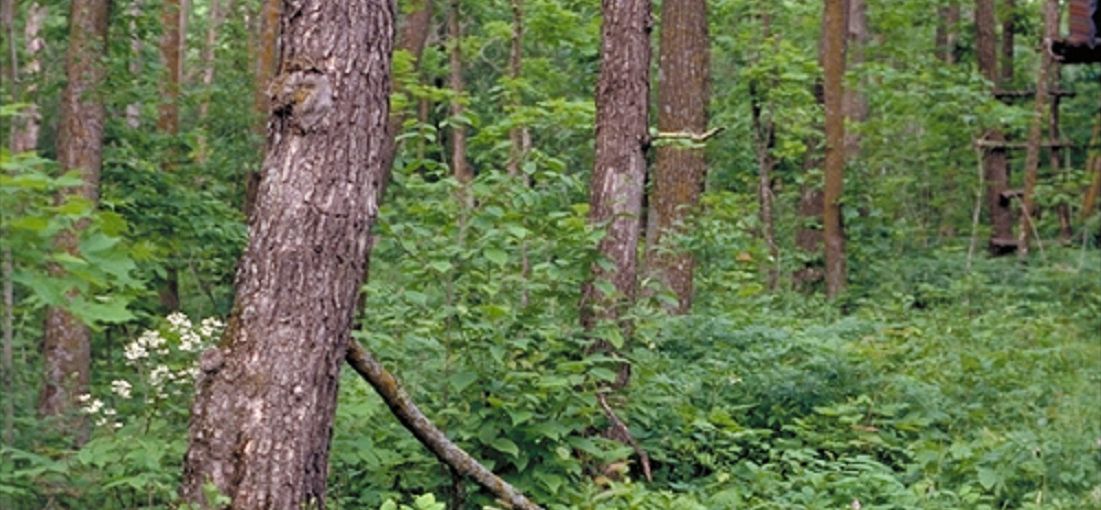
Vegetation Structure & Composition
Description is based on summary of vegetation data from 17 plots (relevés).
- Ground-layer typically is continuous (>75% cover), with lady fern (Athyrium filix-femina) the most abundant species and Clayton’s sweet cicely (Osmorhiza claytonii) and early meadow-rue (Thalictrum dioicum) usually present. Large-leaved aster (Eurybia macrophylla), two-leaved miterwort (Mitella diphylla), and large-flowered bellwort (Uvularia grandiflora) are commonly present. Many grass and sedge species occur in the community, including nodding fescue (Festuca subverticillata), bearded shorthusk (Brachyelytrum erectum), starry sedge (Carex rosea), graceful sedge (C. gracillima), long-stalked sedge (C. pedunculata), Pennsylvania sedge (C. pensylvanica), bladder sedge (C. intumescens), bottlebrush grass (Elymus hystrix), woodland millet grass (Milium effusum), and charming sedge (C. blanda).
- Shrub-layer ranges from sparse to interrupted (25-75% cover). Beaked hazelnut (Corylus cornuta) is present in about 50% of sites and when present, is the most abundant shrub species. Other frequent species include prickly gooseberry (Ribes cynosbati), chokecherry (Prunus virginiana), and nannyberry (Viburnum lentago), along with basswood, black ash, red oak, sugar maple, and blue beech seedlings.
- Subcanopy is interrupted (50-75% cover), with sugar maple, basswood, and ironwood the most abundant species. Other frequent subcanopy species include blue beech, black ash, and bur oak.
- Canopy usually is interrupted (50-75% cover). Basswood and black ash are the most important canopy trees, often occurring with sugar maple, bur oak, northern red oak, green ash, and red maple. When present, white pine may be an important canopy species.
Landscape Setting and Soils
- Till plains — Common. Landscape is undulating with broad flats and long slopes. Parent material is non-calcareous sandy loam till with some gravel. Soils have dense, gray, well-cemented subsoil horizons that perch snowmelt and rainfall. Gray and bright soil colors are present above and below the dense subsoil horizons, indicating periodic saturation in these layers. Soils are somewhat poorly drained. Soil-moisture regime is moist. (WSU)
- Stream terraces and wave-cut benches around lakes — Common. Topography is level. Parent material is non-calcareous alluvium or water-washed till. These sites do not flood, but the water table is near the soil surface in the spring and then falls steadily through the growing season. Gray and bright soil colors, indicating periodic saturation, begin at about 6in (15cm) and continue to depths >60in (150cm). Soils are somewhat poorly drained. Soil-moisture regime is moist. (WSU)