

NPC Page Template
MHn45 - Northern Mesic Hardwood (Cedar) Forest
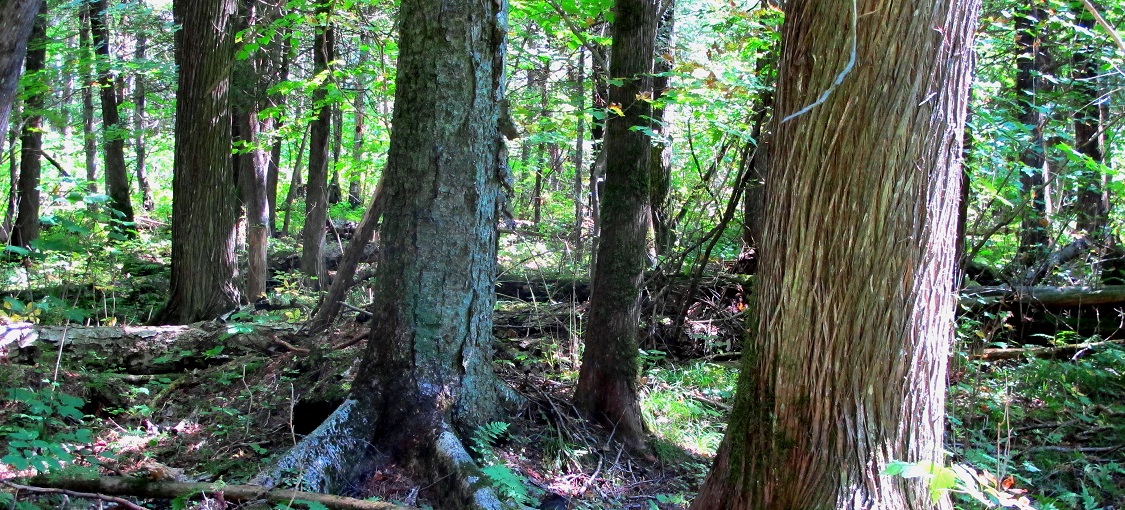
Vegetation Structure & Composition
Description is based on summary of vegetation data from 88 plots (relevés).
- Ground-layer cover is usually <50%, with rose twisted stalk (Streptopus lanceolatus), bluebead lily (Clintonia borealis), wild sarsaparilla (Aralia nudicaulis), Canada mayflower (Maianthemum canadense), and starflower (Lysimachia borealis) the most common species.
- Shrub-layer usually has 50% to >75% cover. Sugar maple seedlings are common and abundant—especially where sugar maple is dominant in the canopy—with smaller amounts of mountain maple (Acer spicatum), beaked hazelnut (Corylus cornuta), chokecherry (Prunus virginiana), and balsam fir.
- Subcanopy cover ranges from patchy (25- 50%) to continuous (75-100%); sugar maple is the most frequent and abundant species.
- Canopy cover is variable, ranging from interrupted (50-75%) to continuous. Canopy is dominated by sugar maple, sometimes with yellow birch as a codominant; by paper birch and sugar maple; or by white cedar and yellow or heart-leaved birch, usually with some sugar maple. White spruce is often present, although seldom abundant.
Landscape Setting and Soils
Scoured bedrock terrain — Common. Present on moderate to steep slopes in rugged terrain. Parent material is a discontinuous mantle of non-calcareous, sandy-loam till, about 20-40in (50-100cm) thick, over bedrock. Lower soil horizons are dense and can perch snowmelt and rainfall but there is no indication of prolonged saturation. Soils are moderately well drained. Soil-moisture regime is moderately fresh. (North Shore Highlands in NSU)