

NPC Page Template
MHn46 - Northern Wet-Mesic Hardwood Forest
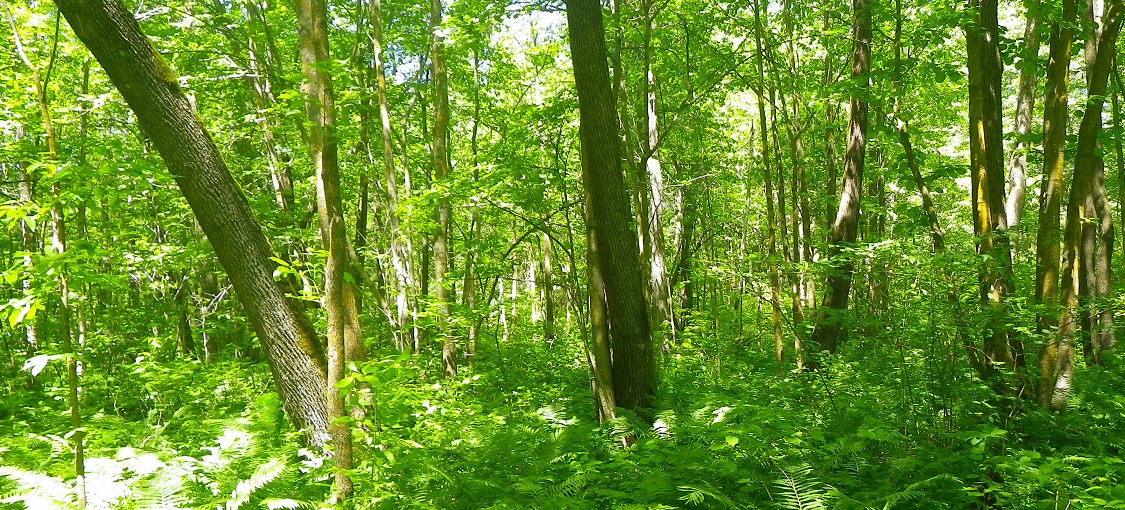
Vegetation Structure & Composition
Description is based on summary of vegetation data from 65 plots (relevés).
- Ground-layer cover ranges from interrupted to continuous (50-100%). Common species include lady fern (Athyrium filix-femina), wild sarsaparilla (Aralia nudicaulis), Canada mayflower (Maianthemum canadense), dwarf raspberry (Rubus pubescens), large-leaved aster (Eurybia macrophylla), and sweet-scented bedstraw (Galium triflorum), with Pennsylvania sedge (Carex pensylvanica) abundant in many sites.
- Shrub-layer has variable cover; beaked hazelnut (Corylus cornuta) and chokecherry (Prunus pensylvanica), and black ash, red maple, and basswood seedlings are the most important species.
- Subcanopy is often present, with black ash, basswood, red maple, and sugar maple the most frequent species.
- Canopy is patchy (25-50% cover) to continuous (>75% cover) and typically dominated by black ash, basswood, or quaking aspen. Other important canopy trees include red maple, bur oak, paper birch, sugar maple, green ash, and occasionally, northern red oak, white cedar, or balsam poplar.
Landscape Setting and Soils
- Till plains — Common. Landscape is level to rolling. Parent material can be either calcareous or non-calcareous till. On calcareous till, heavy clay-loam subsoil horizons are present that hold water throughout much of the growing season. On non-calcareous till, very firm sandy-loam subsoil horizons are present that are capable of perching water throughout the growing season. In both cases, gray soil colors indicate that these horizons are saturated in the spring because of high local water tables, which fall very slowly through the growing season. Soils are somewhat poorly to moderately well drained. Soil-moisture regime is very moist. (WSU, Chippewa Plains in MDL, and Littlefork- Vermillion Uplands in MOP)
- Stagnation moraines — Occasional. Present on level areas within rolling to hummocky landscapes. Parent material is calcareous till with very few stones. Heavy clay-loam subsoil horizons are present that hold water throughout much of the growing season. Gray soil colors indicate that soils are saturated in the spring because of high local water tables, which fall very slowly through the growing season. Soils are some- what poorly drained. Soil-moisture regime is very moist. (MDL (except Tamarack Lowlands) and WSU)
- Glacial lake plains — Occasional. Landscape is level, with water perched over broad areas and the local water table near the surface. Parent material is non-calcareous, stoneless clay. Gray soil colors indicating prolonged saturation are usually present in the upper 60in (150cm). Soils are somewhat poorly to moderately well drained. Soil-moisture regime is very moist. (SSU, Littlefork-Vermillion Uplands in MOP, and Tamarack Lowlands in MDL)