

NPC Page Template
MHn47 - Northern Rich Mesic Hardwood Forest
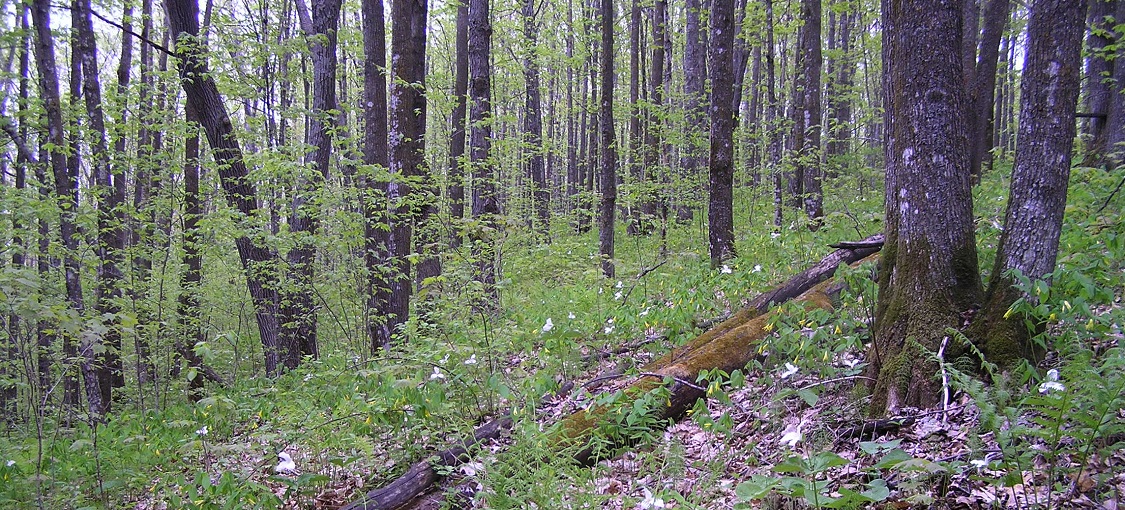
Vegetation Structure & Composition
Description is based on summary of vegetation data from 83 plots (relevés).
- Ground-layer cover ranges from sparse (5-25%) to interrupted (50-75%). The most frequent species are lady fern (Athyrium filix- femina), wild sarsaparilla (Aralia nudicaulis), Clayton’s sweet cicely (Osmorhiza claytonii), hairy Solomon’s seal (Polygonatum pubescens), Canada mayflower (Maianthemum canadense), rose twistedstalk (Streptopus lanceolatus), mountain rice grass (Oryzopsis asperifolia), and Pennsylvania sedge (Carex pensylvanica).
- Shrub-layer cover is variable, ranging from sparse to continuous (>75%). Sugar maple is usually abundant (>35% cover, on average), along with occasional beaked hazelnut (Corylus cornuta), basswood saplings, fly honeysuckle (Lonicera canadensis), mountain maple (Acer spicatum), chokecherry (Prunus virginiana), and ironwood saplings.
- Subcanopy cover ranges from sparse to interrupted (5-75%), with sugar maple usually abundant and ironwood and basswood sometimes abundant.
- Canopy cover ranges from interrupted to continuous (50%-100%) and is dominated by sugar maple, usually with lesser amounts of basswood and often some yellow birch. Paper birch, ironwood, northern red oak, black ash, balsam fir, and white spruce are occasionally present in the canopy.
Landscape Setting and Soils
- Stagnation moraines — Common. Present on relatively level areas in otherwise hummocky landscapes. Parent material is calcareous fine-textured till, usually with a stoneless cap of wind-deposited silt loam or loamy very fine sand. Free carbonates are usually present in the soil below 40in (100cm). Soils have firm, clayey subsoil horizons that perch snowmelt and rainfall, although there is no indication of prolonged saturation. Soils are well or moderately well drained. Soil-moisture regime is fresh. (Chippewa Plains and St. Louis Moraines in MDL; WSU; and North Shore Highlands in NSU)
- Till plains — Common. Landscape is level to rolling. Parent material is calcareous fine-textured till with a cap of very fine sandy loam. In some areas the cap consists of stoneless silt deposited by wind, while in other places the cap contains gravel and was deposited by water. Free carbonates are usually present in the soil below 40in (100cm). Soils have firm, clayey subsoil horizons that perch snowmelt and rainfall, although there is no indication of prolonged saturation. Soils are well or moderately well drained. Soil-moisture regime is fresh. (Chippewa Plains and St. Louis Moraines in MDL; WSU; and North Shore Highlands in NSU)
- Dissected glacial lake sediments — Occasional. Present on gentle to steep slopes in rugged terrain. Parent material is stratified silt and clay. The soil surface is silty and has free carbonates below about 30in (75cm). Soil drainage is dependent on slope; on steeper slopes soils are well drained, and on level areas soils are somewhat poorly drained. Soil-moisture regime is fresh, regardless of slope. (SSU)
- Scoured bedrock terrain — Occasional. Present on level sites in hummocky terrain. Parent material is a discontinuous mantle of mostly non-calcareous, cobbly till, about 20-50in (50-125cm) thick, over bedrock. Lower soil horizons are dense and capable of perching snowmelt and rainfall. Soils are well drained. Soil-moisture regime is fresh. (North Shore Highlands Subsection in NSU)