

NPC Page Template
MHs37 - Southern Dry-Mesic Oak Forest
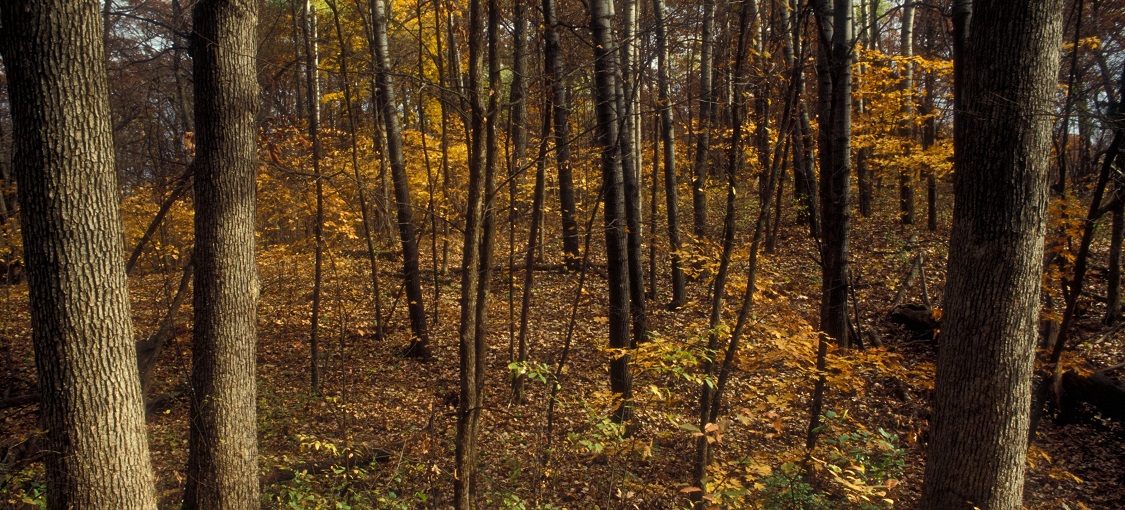
Vegetation Structure & Composition
Description is based on summary of vegetation data from 43 plots (relevés).
- Ground-layer cover varies from patchy to continuous (25-100%); important species include lady fern (Athyrium filix-femina), pointed-leaved tick trefoil (Desmodium glutinosum), Clayton’s sweet cicely (Osmorhiza claytonii), common enchanter’s nightshade (Circaea lutetiana), wild geranium (Geranium maculatum), hog peanut (Amphicarpaea bracteata), and white snakeroot (Ageratina altissima).
- Shrub-layer cover is patchy to interrupted (25-75%); common species include northern red oak and black cherry saplings, chokecherry (Prunus virginiana), American hazelnut (Corylus americana), Missouri gooseberry (Ribes missouriense), and pagoda dogwood (Cornus alternifolia).
- Subcanopy cover is patchy to interrupted (25-75%); important species include basswood, black cherry, northern red oak, white oak, and shagbark hickory.
- Canopy cover is interrupted to continuous (50-100%); the most common species are northern red oak, white oak, and basswood. Shagbark hickory is occasionally present in the PPL.
Landscape Setting and Soils
- Loess-covered bedrock hills — Common. Present mainly on crests and upper slopes of bedrock bluffs. Most common on north-facing aspects on steeper slopes but also present on west- or east-facing crests and middle to upper slopes. Parent material is a mantle of wind-deposited silt deeper than 30 in (75cm) over older soils, with texture that reflects the composition of the underlying sedimentary bedrock, Depths to bedrock generally exceed 60in (150cm). The silt is typically stoneless, but the soil becomes very stony just above the bedrock. Soils have dark surface horizons, indicating former occupation of these sites by oak or aspen woodland. Soils are well drained, and the soil-moisture regime is fresh. (Blufflands in PPL)
- Stagnation moraines & till plains — Rare. Present on hummocky stagnation moraines and rolling parts of till plains. Parent material is calcareous, partially sorted drift. The surface is generally loamy but soils become sandy and gravelly at depth. Soil surface horizons are dark, indicating former occupation of these sites by oak woodland or prairie. Soils are well drained, and the soil moisture regime is fresh. (Big Woods, St. Paul-Baldwin Plains and Moraines, and Oak Savanna in MIM, Rochester Plateau in PPL)