

NPC Page Template
MHs39 - Southern Mesic Maple-Basswood Forest
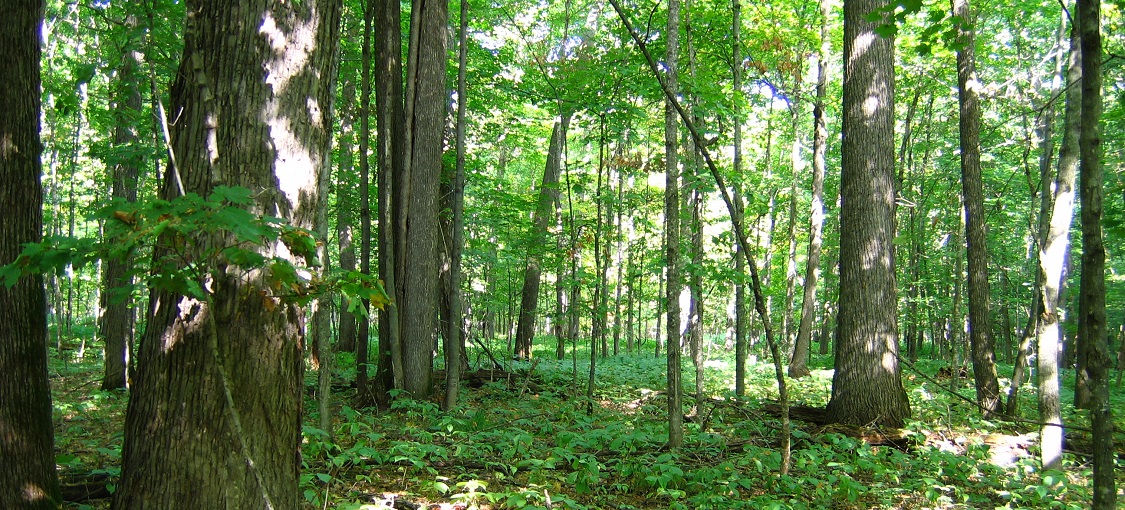
Vegetation Structure & Composition
Description is based on summary of vegetation data from 110 plots (relevés).
- Ground-layer cover is interrupted to continuous (50-100%); important species include Virginia waterleaf (Hydrophyllum virginianum), bloodroot (Sanguinaria canadensis), rugulose or yellow violet (Viola canadensis or V. pubescens), large-flowered bellwort (Uvularia grandiflora), wild leek (Allium tricoccum), blue cohosh (Caulophyllum thalictroides), and early meadow-rue (Thalictrum dioicum). Spring ephemeral species such as cut-leaved toothwort (Cardamine concatenate) and Dutchman’s breeches (Dicentra cucullaria) are characteristic.
- Shrub-layer cover is rare to interrupted (5-75%); common species include sugar maple, bitternut hickory, basswood, prickly gooseberry (Ribes cynosbati), and chokecherry (Prunus virginiana).
- Subcanopy cover is most commonly patchy to interrupted (25-75%); important species include sugar maple, ironwood, basswood, and bitternut hickory.
- Canopy cover is interrupted to continuous (50-100%) and strongly dominated by sugar maple, with basswood, northern red oak, and occasionally red elm and American elm.
Landscape Setting and Soils
- Stagnation moraines — Occasional. Present on rolling to hummocky topography with complex slopes. Parent material is strongly calcareous till with little gravel and few stones. Soil surface is loamy and dark colored to about 1in (25cm), indicating former occupation of these sites by oak or aspen woodland. Soils have a very thick clay-loam subsoil horizon, but there is no indication that it perches or retains water for long periods of time. Gray soil colors and deposits of free carbonates are common below the clay-loam horizon, indicating availability of water and nutrients below clay layer. Soils are well drained. Soil-moisture regime is fresh or very fresh. (Big Woods, Hardwood Hills, and Oak Savanna in MIM; localized along large lakes in MDL and WSU)
- Till plains — Common. Present on rolling topography, with most occurrences on north aspects. Parent material is strongly calcareous, fine-textured till with little gravel and few stones. Soil surface is loamy and dark to about 10in (25cm), indicating former occupation of these sites by oak or aspen woodland. Soils have a very thick clay-loam subsoil horizon but there is no indication that it perches or retains water for long periods of time. Gray soil colors and deposits of free carbonates are common below the clay-loam horizon, indicating availability of water and nutrients below the clay layer. Soils are well drained. Soil-moisture regime is fresh or very fresh. (Big Woods, Hardwood Hills, and Oak Savanna in MIM; localized along large lakes in MDL and WSU; localized in CGP)
- Loess-covered or drift-covered bedrock bluffs — Occasional. Most often present on middle and lower slopes with strong affinity for north and northeast aspects. Parent material is wind-deposited silt that is generally deeper than 60in (150cm) over sedimentary bedrock. Flagstone-sized rocks are common just above the bedrock. Soils have dark, organic-rich surface horizons, indicating former occupation of these sites by oak woodland or prairie. Little clay is available for development of subsoil horizons capable of perching snowmelt and rainfall. Soils are well drained. Soil-moisture regime is fresh. (Blufflands in PPL; MIM)