

NPC Page Template
WFn64 - Northern Very Wet Ash Swamp
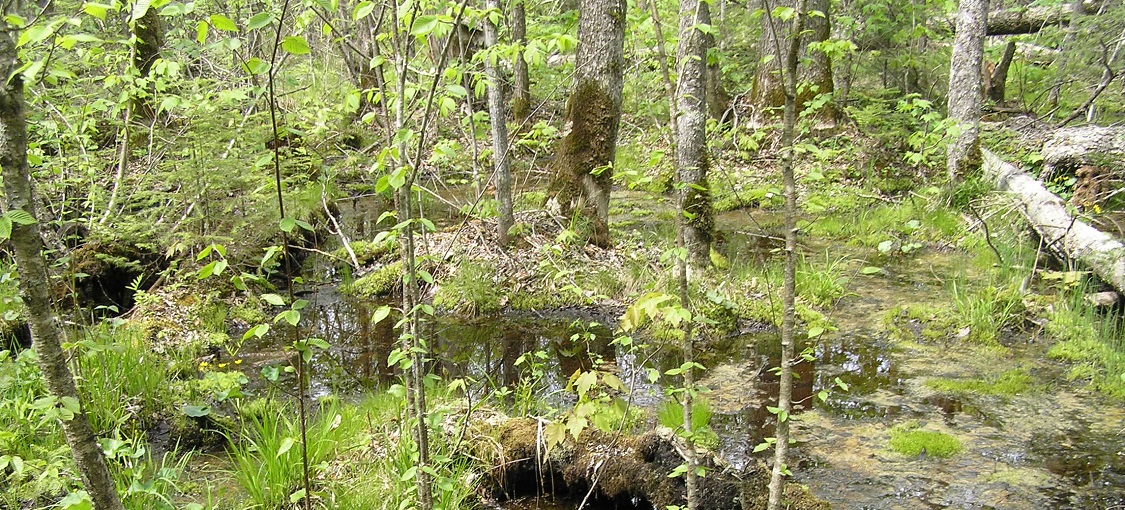
Vegetation Structure & Composition
Description is based on summary of vegetation data from 75 plots (relevés).
- Ground-layer cover is usually >50%. Wet forest species are common, especially dwarf raspberry (Rubus pubescens), common marsh marigold (Caltha palustris), touch- me-not (Impatiens spp.), northern bugleweed (Lycopus uniflorus), and naked miterwort (Mitella nuda). Broad-leaved graminoids such as fowl manna grass (Glyceria striata), bluejoint (Calamagrostis canadensis), and lake sedge (Carex lacustris) are sometimes abundant in the ground layer. Mosses generally are sparse, except for epiphytic species on black ash boles.
- Shrub-layer cover ranges from sparse (5-25%) to continuous (75-100%), with black ash and speckled alder (Alnus incana) frequent and sometimes abundant; mountain maple (Acer spicatum) is also occasionally abundant.
- Subcanopy is patchy (25-50% cover); black ash is most abundant, with occasional red maple, balsam fir, yellow birch, American elm, white cedar, or paper birch.
- Canopy is patchy to interrupted (25-75% cover) and dominated by black ash, sometimes with moderate amounts of white cedar, balsam fir, tamarack, yellow birch, red maple, or white spruce.
Landscape Setting and Soils
WFn64 occurs on many types of landforms, most often in small closed depressions, although it can also occur around the margins of large basins with deep, actively growing peatlands at their centers. The parent material can be of almost any texture. Soils typically consist of 10-40in (25-100cm) of sapric peat over mineral soil, usually with a thin layer of muck at the soil surface. Gray colors are present in the mineral soil, indicating permanent saturation. Mucky pools and saturated logs provide the main substrates for plants. Soils are very poorly drained. Soil-moisture regime is moderately wet to very wet. (LAP, MOP, NSU, MDL, WSU, SSU, Anoka Sand Plain Subsection in MIM)